 how-to
Homework Help for Kids With Dyslexia: A Parent's Guide
Table of Contents
- Set Up a Dyslexia-Friendly Homework Space and Routine
- Homework Accommodations for Dyslexia: What to Ask For
- Assistive Technology for Dyslexia: Tools That Build Independence
- Dyslexia and Math Homework: Making Numbers Make Sense
- Reducing Homework Stress for Kids With Dyslexia
- Subject-by-Subject Workflow: Reading, Writing, Spelling, and More
- Age- and Skill-Specific Guidance for K-5
- Conclusion
- Frequently Asked Questions
Last Updated: October 21, 2026
Set Up a Dyslexia-Friendly Homework Space and Routine
Homework help for kids with dyslexia starts with two things you control before a worksheet comes out: the space your child works in and the time they start.
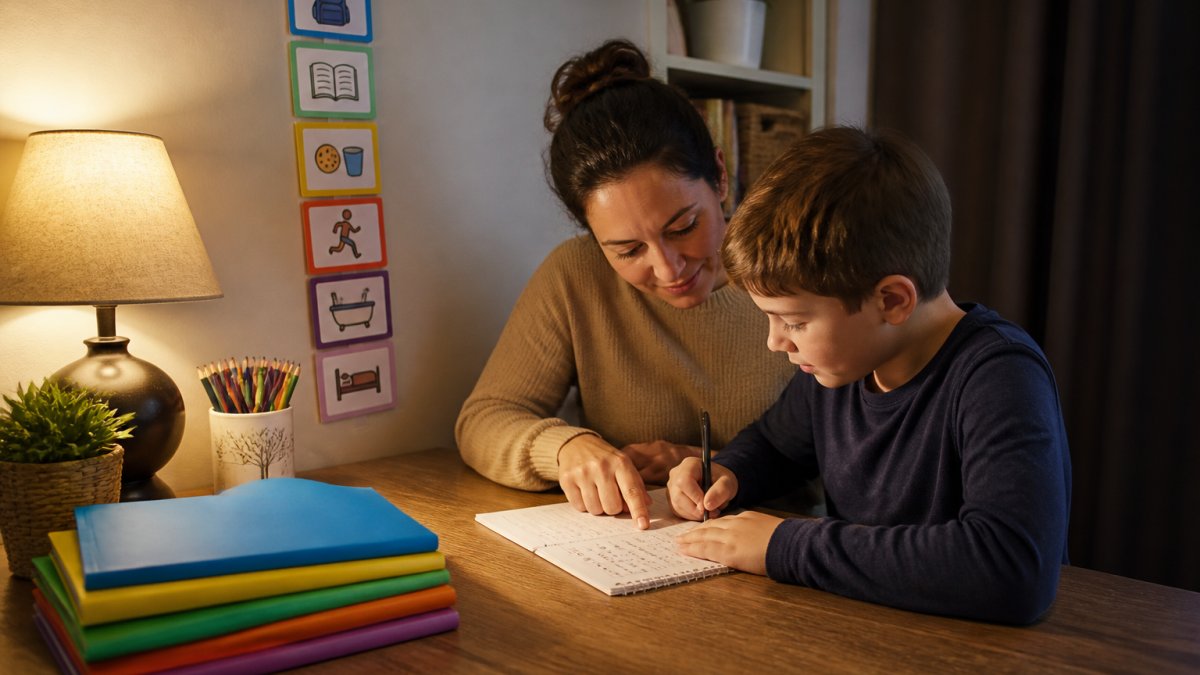
Dyslexia is a learning difference affecting how the brain processes written language, particularly decoding words and connecting letters to sounds.
That exhaustion matters. Kids with dyslexia often spend far more energy reading than their classmates, so homework can take roughly twice as long for students with reading difficulties.
Design a Quiet, Organized Work Area
A good homework environment cuts distractions, keeps supplies within reach, and gives your child a predictable place to land.
- Pick a low-traffic spot. Away from the TV, the kitchen sink, and siblings playing.
- Use good light. A desk lamp beats a dim corner every time.
- Keep a supply caddy. Pencils, eraser, highlighters, sticky notes, and a ruler in one box.
The clutter rule matters most: a pile of unfinished worksheets reads as failure to a child who already feels behind. Put finished work in a folder, out of sight.
Establish a Consistent Homework Schedule
Set the same start time every school day. Predictability lowers anxiety for kids who spend all day working to keep up.
A common mistake is starting the moment your child walks in. Most kids need a 20- to 30-minute brain break first, snack, water, movement, before beginning.
Homework Accommodations for Dyslexia: What to Ask For
Homework accommodations for dyslexia are formal adjustments so your child can show what they know without being blocked by reading and spelling. They are not a shortcut; they level the field.
Ask for these in writing, and request a meeting rather than a hallway conversation.
- Extra time on tests and timed reading tasks
- Reduced homework volume, with quality prioritized over quantity
- Printed notes or a study guide instead of copying from the board
Working With Teachers and Using Accommodations
Treat the teacher as a partner. Most want to help and simply do not know what your child needs at home.
Bring three things: a short list of what you see at home, the specific accommodations you want, and a question about how progress will be tracked.
The International Dyslexia Association's guidance for parents is a strong starting point for language you can borrow in that conversation.
A Parent-Teacher Meeting Script You Can Borrow
Most parents leave without a clear answer because they never asked a question that requires one. Use this four-step script.
- Open with observation, not accusation. "Here is what homework looks like at our kitchen table on a typical Tuesday." Bring two or three specific examples, time spent, tears, avoided tasks, not general frustration.
- Name the barrier, not the diagnosis. "Reading the directions aloud takes ten minutes before the math even starts." This keeps the conversation on the task, not on labels.
- Ask for one change at a time. Request the accommodation most likely to reduce nightly friction first, usually reduced volume or audio versions, and ask how the teacher will know it is working.
- Close with a written follow-up. "I'll send a short email summarizing what we agreed so we both have it." This creates a paper trail without confrontation.
A common pattern is that teachers agree in the meeting but the accommodation never reaches the homework folder. The email follow-up prevents that drift.
Track Whether Accommodations Are Actually Working
Accommodations only work if someone checks them. Keep a two-week log with three columns: assignment, accommodation used, and outcome (finished, partially finished, abandoned). Bring it to the next check-in.
If the log shows the accommodation is not being applied, ask the teacher how assignments are sent home. If it is applied but homework still runs past bedtime, the issue is workload, not access, a different conversation.
Formal Supports Beyond the Classroom
If informal accommodations are not enough, ask in writing about a formal evaluation. A written request starts the clock, and schools are generally required to respond within a set timeline. The International Dyslexia Association's fact sheets on school supports explain the difference between classroom accommodations and a formal plan. Do not wait for the school to raise concerns first, parents are usually the first to notice, and evaluation waitlists can be long.
Assistive Technology for Dyslexia: Tools That Build Independence
Assistive technology for dyslexia covers any tool that removes the reading or writing barrier so your child can focus on thinking.
The goal is independence, not dependence. A child who hears a word read aloud and then reads it again is building skill.
Here is where a tool like K5 Homework Aid For Parents fits. Text-to-speech reads it aloud, helping auditory learners and early readers.
- Text-to-speech for reading practice and word problems
- Speech-to-text for drafting written assignments
- Audiobooks paired with the printed page
Dyslexia and Math Homework: Making Numbers Make Sense
Dyslexia and math homework collide more than parents expect. A word problem is a reading task first; if decoding is slow, the math never gets a chance.
Dyscalculia, a related difficulty with number sense, can show up alongside dyslexia.
Try these moves:
- Read the problem aloud together, then ask your child to explain it back
- Draw it. Sketch the story problem as a picture before writing any numbers
- Use graph paper to keep columns aligned
Long division taught today rarely matches what you learned. Ask the teacher for a worked example, or use a tool that mirrors the classroom method.
Reducing Homework Stress for Kids With Dyslexia
Reducing homework stress for kids with dyslexia means lowering the stakes and shortening the runway. Stress shuts down working memory, exactly what reading and math demand.
Signs to watch for:
- Tears or anger at the same point every night
- Stalling, bathroom trips, sudden hunger
- Headaches or stomachaches before homework
If you see these, stop the session. A 10-minute break with water, a protein snack, and movement resets the brain better than pushing through.
When Distress Signals a Need for More Support
Occasional frustration is normal. A pattern of daily distress is information.
Talk to the school if your child is consistently melting down, if homework regularly runs past a reasonable bedtime, or if you suspect an unassessed reading difficulty. Ask about a formal evaluation. Early identification opens the door to structured literacy instruction, the approach with the strongest evidence base for dyslexia.
A Two-Week Distress Log That Turns Feelings Into Data
Schools respond to patterns, not one bad night. Before calling a meeting, track two weeks of sessions in a log with four columns: date, subject, minutes until distress, and what happened (tears, avoidance, headache, refusal).
A common pattern is that distress clusters around one subject or task, reading directions, copying from the board, or timed math facts. That cluster is the barrier to bring to the teacher.
Three Escalation Tiers
Use this framework to decide how urgently to act.
- Tier 1, Normal friction. Occasional frustration, a rough night after a long day. Response: shorten the session, add a break, and note it. No school contact needed.
- Tier 2, Repeating pattern. Distress three or more nights in a week, homework regularly past bedtime, or a subject your child avoids every time. Response: email the teacher with the log, request one accommodation, and set a two-week check-in.
- Tier 3, Persistent distress or suspected unassessed difficulty. Daily meltdowns, physical symptoms, refusal to attend school, or a suspicion that reading difficulty has never been evaluated. Response: written request for a formal evaluation and a meeting with the school's support team.
What to Say When Your Child Says "I'm Stupid"
It is not a request for reassurance, it is a request for evidence that the task is the problem, not the child.
Try naming the task, not the feeling: "This worksheet is badly designed for the way you read. That is the worksheet's problem, not yours." Then reduce the task to one item and finish it together. A child who ends the night having completed one thing successfully has evidence that homework is survivable.
Subject-by-Subject Workflow: Reading, Writing, Spelling, and More
A subject-by-subject workflow gives you a repeatable plan instead of improvising nightly. Here is the sequence we recommend.
| Subject | First Move | Then | Watch For |
|---|---|---|---|
| Reading | Preview the title and pictures | Read aloud together, then echo-read | Guessing from the first letter |
| Writing | Talk the answer out loud | Speech-to-text or scribe, then edit | Blank-page freeze |
| Spelling | Say the word, tap the sounds | Multisensory practice: write, say, trace | Copying without sounding out |
| Math | Read the problem aloud | Draw it, then solve step by step | Column misalignment |
| Science and social studies | Listen to the chapter first | Build a mind map or color-coded notes | Losing the main idea in the text |
For reading, use guided reading and short reading activities rather than long passages.
For spelling, multisensory learning works: see it, say it, hear it, write it.
For written assignments, separate ideas from mechanics. Let your child dictate the answer, then work on spelling separately.
Age- and Skill-Specific Guidance for K-5
What works for a kindergartner will frustrate a fifth grader. Match support to the stage.
- Kindergarten to Grade 1: Sit beside your child. Focus on sounds, letters, and short reading practice. Keep sessions to 10 to 15 minutes.
- Grades 2 to 3: Build the homework routine and a written plan. Introduce text-to-speech. Teach your child to check off a task list.
- Grades 4 to 5: Shift toward independence. Your child sets the task list; you review it. Add time management practice and deadlines for longer projects.
Across every grade, protect independence. The goal is a child who can eventually run homework alone, not one who needs you at the table forever.
Conclusion
Homework with a dyslexic child is hard, and it reflects neither your parenting nor your child's intelligence.
That is exactly what we built K5 Homework Aid For Parents to do. Snap a photo, get a grade-appropriate explanation that matches the teacher's method, and let text-to-speech read it aloud. Save, print, or share the result as a PDF for the teacher.
Frequently Asked Questions
How can I help my child with dyslexia with homework without doing the work for them?
Focus on breaking assignments into smaller, manageable steps and asking guiding questions instead of giving answers. Use a written plan or task list so your child can check off each step. For reading, try paired reading or text-to-speech tools, and encourage your child to explain the method back to you. This builds independence and confidence while reducing homework stress for kids with dyslexia.
What tools can help a child with dyslexia complete homework?
Assistive technology for dyslexia includes text-to-speech apps, audiobooks, speech-to-text dictation, and multisensory learning tools like colored overlays or letter tiles. A photo-based homework helper that explains concepts in age-appropriate language can also support understanding across subjects. These tools give children more ways to access the material and show what they know.
How long should homework take for a child with dyslexia?
Expect it to take roughly twice as long as for peers, so a 20-minute assignment may take 40 minutes. Use a timer and build in short brain breaks every 10-15 minutes. If homework consistently exceeds a reasonable time, discuss workload adjustments with the teacher. The goal is meaningful practice, not exhaustion.
Can dyslexia make homework harder on some days?
Yes, fatigue, stress, or a busy day can make reading and writing feel more difficult. Keep a consistent schedule and allow time to decompress after school. On harder days, shorten tasks or switch to an easier subject first. Recognizing these fluctuations helps you respond with support rather than frustration.