 how-to
How Do You Stop a Child From Copying Homework?
Quick Summary
Stop copying homework by first finding out why it happened, then talking with your child privately and asking them to walk you through the work. Respond with a proportionate plan: reteach a confusing skill, shorten the task, or redo the assignment independently, and check the same skill again within 24 hours.
- Check the facts quietly before confronting your child, comparing handwriting, spacing and mistakes with their usual work.
- Choose a private moment, sit side by side, and avoid bedtime or rushed mornings.
- Ask your child to show how they got an answer, and let silence invite the truth.
- Describe the work rather than labeling your child as a cheater.
- Agree on one proportionate next step and write it down in one or two sentences.
Table of Contents
- Why Children Copy Homework Answers
- Step-by-Step: What to Do the Moment You Discover Copying
- What to Say When a Child Copies Homework
- Telling Copying From Collaboration
- How to Help a Child Do Homework Independently
- When and How to Involve the Teacher
- Homework Help Tools for Parents: Choosing Support That Teaches
- Planning Your First Week of Independent Homework Habits
- Frequently Asked Questions
How Do You Stop a Child From Copying Homework?
Last Updated: November 5, 2026
Why Children Copy Homework Answers
Copying homework is one of the most common worries parents face, and it is rarely about laziness alone. When a child copies answers, something in the homework feels too hard, too boring, or too risky to try alone.
Most children copy because they feel stuck, not because they want to cheat. A child afraid of a wrong answer may copy to avoid the sting of being wrong in front of a parent or teacher.
Common reasons children copy:
- They do not understand the task
- They fear getting the answer wrong
- They are tired at the end of a long school day
- They think the work is pointless or too repetitive
- They have fallen behind and feel overwhelmed
Identifying the Real Reason Behind the Copying
Before you respond, figure out why the copying happened. The reason changes what you should do next.
Ask your child simple, calm questions:
- "Which part felt hardest?"
- "What did you try before you looked at the answer?"
- "Did something confuse you about the directions?"
A child who says "I don't get it" needs a different response than one who says "I didn't want to do it." Listen first, then decide. Asking a shame-filled question like "Why would you do that?" usually shuts the conversation down before you learn anything.
Age-Specific Causes in K-5
The reasons children copy shift as they grow. Younger children often copy because the methods look unfamiliar. A parent who learned a different method may not recognize the steps, and a child may copy because the page looks impossible.
Older children in grades four and five more often copy to save time or avoid frustration with longer assignments. Their work also becomes more independent, so they may feel embarrassed to ask for help.
Step-by-Step: What to Do the Moment You Discover Copying
Most advice about copying jumps straight to consequences.
1. Pause and check the facts before you say anything.
Do not confront your child the second you notice identical answers. First, gather evidence quietly.
2. Choose a private, low-pressure moment.
3. Ask one open question, then listen.
4. Name what you observed without labeling your child.
Describe the work, not the character. Keeping the conversation focused on what your child understands can also help improve child focus at home, where steady attention makes it easier to do independent work.
5. Agree on a proportionate next step.
Match the response to what you found.
6. Close the loop within 24 hours.
Check the same skill the next day with a fresh problem.
7. Decide whether the teacher needs to know now or later.
Not every incident needs a same-day email.
The first ten minutes after you discover copying matter most. The table below summarises the seven steps.
| Step | What to do | Timing |
|---|---|---|
| 1. Check the facts | Compare work with your child's usual work; note two or three examples | Before speaking to your child |
| 2. Choose a private moment | Talk somewhere without siblings or an audience | Not at bedtime or in a rush |
| 3. Ask one open question | Ask your child to walk you through the work, then listen | During the conversation |
| 4. Name what you observed | Describe the work, not your child's character | During the conversation |
| 5. Agree on a next step | Match the response to what you found and write it down | Same conversation |
| 6. Close the loop | Check the same skill with a fresh problem and praise specific effort | Within 24 hours |
| 7. Decide on teacher contact | Tell the teacher if submitted, repeated, or unexplained | Within a day or two if needed |
What to Say When a Child Copies Homework
Your words matter as much as your actions. Keep the focus on learning, not on blame.
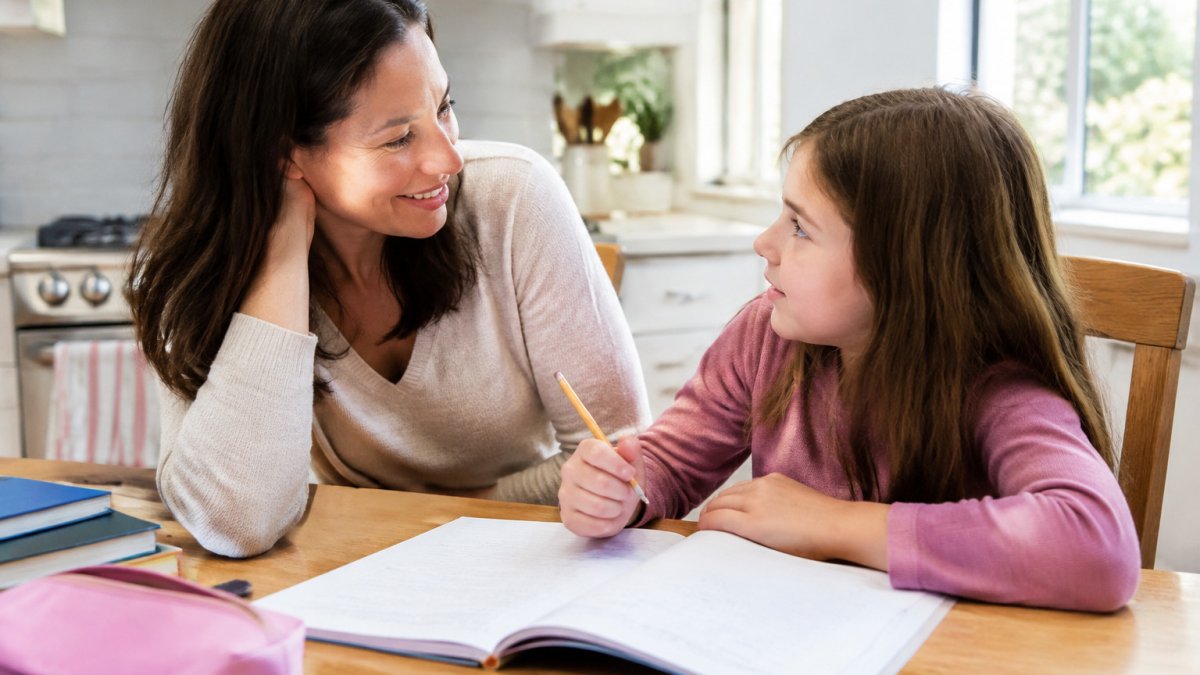
Try phrases like these:
- "I noticed these answers look like they came from somewhere else. Can you walk me through one?"
- "It's okay to feel stuck. Let's find the step that's tripping you up."
- "Your teacher wants to see what you know. Let's figure out what's confusing."
Avoid phrases like "You're a liar" or "You always do this." Labels make children defensive and less likely to tell you the truth next time.
Some parents find it helps to use a calm, shared routine. Sit side by side, not across from each other, and work through one problem together. This makes the conversation feel like teamwork.
Telling Copying From Collaboration
Not all shared work is cheating. Many teachers encourage children to talk through problems with a friend or family member. The difference lies in who does the thinking.
Collaboration usually looks like this:
- Both children explain their reasoning out loud
- Each child writes their own answers in their own words
- They check each other's understanding, not just final answers
Copying usually looks like this:
- One child writes down the other's answers without understanding them
- The work is identical, down to mistakes and spacing
- The child cannot explain how they got the answer
If you are unsure, ask your child to explain a single answer in their own words. That quick test usually shows whether learning happened.
How to Help a Child Do Homework Independently
Independent homework habits do not appear overnight. They grow when a child feels able to start, keep going, and check their own work.
Build these habits gradually:
- Set the same homework time and place each day
- Keep supplies within reach so your child does not stall
- Praise effort and strategy, not only correct answers
- Let your child try first, even when you could solve it faster
Breaking Assignments Into Smaller Steps
Large assignments can feel impossible, and that feeling is a major reason children copy. Break each task into small pieces.
- Read the directions together and circle the key words
- Complete the first two problems, then pause
- Check those answers before moving on
- Use a timer for short work bursts with breaks in between
Small wins build confidence. A child who finishes three short steps is more likely to finish the whole assignment honestly.
When and How to Involve the Teacher
Copying is rarely solved at home alone.
When to contact the teacher
Reach out if any of these are true:
- The copied work was submitted for a grade
- Copying has happened more than once, even after a calm conversation at home
- Your child cannot explain the skill, which suggests a real learning gap
- Your child seems anxious, avoidant, or unhappy about schoolwork
- You suspect the assignment is too hard, too long, or unclear
- Another child or parent is involved and you need the school's view
For a first, small incident that your child redoes honestly, a brief note is often enough.
What to say in the first message
Keep it short, factual, and free of blame.
Avoid opening with a demand for punishment or a defense of your child.
Questions worth asking
- What does the assignment ask students to show, and how is it graded?
- Does my child participate and ask for help in class?
- Is this skill one the class has practiced, or is it new?
- What does the school policy say about copied homework, and what happens in practice?
- How can we coordinate so home and school use the same method?
That last question matters more than it sounds.
Understanding school policy without overreacting
Most schools distinguish between collaboration, copying, and plagiarism, and consequences usually scale with intent and repetition.
Coordinating support after the conversation
Agree on two or three concrete actions and who owns each one. For example: the teacher provides extra practice on a specific skill; you check the first problem each night before your child continues; your child asks one question in class before the end of the week. Ask how the teacher prefers updates, such as a weekly note or short email, and keep the loop short. A brief follow-up after two weeks is usually enough to confirm whether the plan is working.
If the problem continues despite these steps, ask for a short meeting rather than a longer email exchange.
Homework Help Tools for Parents: Choosing Support That Teaches
Many families now use apps and online tools to support homework. The best choice is one that explains the method behind an answer, not one that simply provides the final result.
When you compare options, look for:
- Clear, step-by-step explanations at your child's grade level
- Explanations that match the methods your child's teacher uses
- Accessibility features such as text-to-speech for children who read slowly
- Simple privacy policies that explain how uploaded photos are handled
K5 Homework Aid For Parents shows the method behind each answer, and it includes text-to-speech for children who struggle with reading. Results can be saved or shared as a PDF.
Use any tool as a helper, not a replacement. Sit with your child while they use it, and ask them to explain the steps back to you.
Planning Your First Week of Independent Homework Habits
A short, clear plan helps you start without overwhelming your child. Try this simple seven-day outline.
- Day 1: Choose a fixed homework time and workspace
- Day 2: Read through the week's assignments together
- Day 3: Practice breaking one assignment into small steps
- Day 4: Have your child explain one answer aloud
- Day 5: Check one completed assignment together, focusing on method
- Day 6: Praise one specific effort your child made this week
- Day 7: Review what went well and choose one thing to improve
Keep the plan flexible. Some weeks will go better than others, and that is normal. The steady habit of trying, explaining, and checking is what makes independent homework stick.
Frequently Asked Questions
Is sharing homework answers cheating?
Yes, in most schools it is treated as academic dishonesty, even when it feels friendly. Giving a classmate the final answers takes away the chance for them to practise the method, and it can get both children in trouble. The clearer approach is to tell your child that helping means explaining how to solve a problem, not handing over the result. Check your child's school policy, since rules on collaboration and sharing vary between classrooms and teachers.
How should parents respond when a child copies homework?
Stay calm and treat it as a learning problem, not only a behaviour problem. Ask your child to explain one answer in their own words, which quickly shows whether they understood it. Then talk about why the work was hard to do alone. Avoid harsh punishment as the first step, because it can make a child hide the next incident. If the copying repeats, contact the teacher so you can agree on a shared plan.
How can I help my child do homework independently?
Sit nearby at the start, then gradually step back. Help your child break the assignment into small tasks and check off each one. Ask guiding questions such as 'What do you know about this?' rather than giving the answer. Set a consistent time and place for homework so it becomes routine. Praise effort and correct approaches, not only correct results, so your child feels confident trying on their own.
When should I contact my child's teacher about copied homework?
Contact the teacher if copying happens more than once, if your child seems unable to do the work even with support, or if the copied work is being turned in without any effort. Teachers can share what they see in class, which helps you understand whether the difficulty is with a specific skill. Ask for a joint approach so your child receives the same message at school and at home.
Start building honest homework habits today. Try K5 Homework Aid For Parents to explain the method behind each problem, with automatic grade detection, text-to-speech support, and easy sharing, so your child learns the "why" and you get calmer homework time. Download Free to see how it fits your family's routine.