 How-to
How to Support Math Anxiety in Elementary Students
Last Updated: November 14, 2026
Quick Summary
Support math anxiety in elementary students by lowering the stakes and matching your response to the child's age: use predictable warm-ups and manipulatives in K-2, and low-stakes retrieval and error analysis in grades 3-5. When anxiety peaks, pause the task, name the feeling, breathe together, shrink the step, and return gently rather than pushing through tears.
- A child showing three or more math anxiety symptoms regularly is signaling distress, not attitude.
- In grades 3-5, use ungraded warm-ups and assign group roles so no student is put on the spot.
- At homework time, start with the easiest problem and take a two-minute break at the first sign of tears.
- An anxious child often knows the method but freezes, while a skill gap shows up even in calm moments.
- Track avoidance, independent starts, persistence, help-seeking, and recovery time weekly on a shared sheet.
Table of Contents
- How to Alleviate Math Anxiety: Start With the Signs
- How to Reduce Math Anxiety in the Classroom
- Calming Math Homework Anxiety at the Kitchen Table
- Building Math Confidence Through Small Successes
- A Step-by-Step Response Plan for Moments of Acute Anxiety
- Telling Math Anxiety Apart From Skill Gaps and Learning Differences
- Tracking Progress and Coordinating Home-School Support
- Download the App and Make Tonight's Homework Calmer
- Frequently Asked Questions
How to Alleviate Math Anxiety: Start With the Signs
Learning how to support math anxiety in elementary students begins with recognizing what anxiety actually looks like in a child. Math anxiety is a genuine emotional response to math tasks, not laziness or a lack of ability. Parents often mistake a child's dread of math for stubbornness. It rarely is. The American Psychological Association's guidance on anxiety in children notes that anxiety in children often shows up as avoidance or irritability rather than open fear.
Math Anxiety Symptoms to Watch For at Home and in Class
Watch for patterns, not one-off bad days. Common math anxiety symptoms include:
- Stalling before math homework starts, or suddenly needing the bathroom
- Physical complaints like stomachaches or headaches before a math lesson
- Tears, anger, or silence when a worksheet comes out
- Saying "I'm just bad at math" before even trying
- Guessing wildly to end the task fast
- Avoiding raising a hand in class, even when the answer is known
A child showing three or more of these regularly is signaling distress, not attitude.
How to Reduce Math Anxiety in the Classroom
Reducing anxiety in class starts with lowering the stakes and matching the strategy to the child's developmental stage. A first grader and a fifth grader experience math anxiety differently, and the same move that calms one can embarrass the other. Age-specific guidance is often where generic advice breaks down.
Early elementary (K-2): safety and predictability
Young children rarely say "I'm anxious about math." They show it through clinginess, tears, or refusal. At this stage, the goal is predictability and play:
- Routine warm-ups: a two-minute counting or pattern game the child already knows how to do, so the lesson starts with a guaranteed success.
- Manipulatives first: counters, ten-frames, and number lines let children show thinking without writing, which removes the fear of a wrong mark on paper.
- Private correction: crouch beside the desk and point to the step, rather than announcing an error to the class.
- Language of approximation: "Show me how you're thinking about it" instead of "What's the answer?"
Upper elementary (grades 3-5): identity and risk-taking
By third grade, children have begun to sort themselves into "math people" and "not math people." Anxiety at this stage is often tied to peer comparison and to the fear of looking dumb in front of friends. Strategies shift:
- Low-stakes retrieval: quick, ungraded warm-ups (whiteboards, thumbs up/down, exit tickets not entered in the gradebook) let students practice without a permanent record.
- Worked examples spoken aloud: the teacher narrates the full method, including the decision points, before independent work. This models that experts pause and reconsider.
- Anchor charts and reference tools posted where students can check them privately, so asking for help doesn't require a public hand-raise.
- Group roles in collaborative work: assign roles (recorder, checker, explainer) so every student has a defined contribution and no one is put on the spot.
- Error analysis as a routine: present a solved problem with a deliberate mistake and ask the class to find it. This normalizes mistakes as content, not character flaws.
The equity and math-identity layer
Anxiety doesn't develop in a vacuum. Stereotypes about who is "good at math," prior experiences with being corrected publicly, language access, and a sense of belonging all shape whether a child raises a hand. A few concrete moves:
- Audit who gets called on and who gets wait time. A common pattern is that anxious students are given less think time, which confirms their fear that they are slow.
- Use names and examples that reflect the class. Belonging is built through small signals.
- Watch language access. A multilingual learner may be anxious about the English of a word problem, not the math. Offer a visual or a translated glossary before assuming a skill gap.
- Separate behavior from identity. "You're not a math person yet" is a growth-mindset phrase; "You're bad at math" is a label that sticks.
The National Council of Teachers of Mathematics stresses that a supportive classroom climate is central to math confidence. When a child feels emotionally safe, they attempt harder problems. Read more in our parent's guide to helping an elementary child with math.
Calming Math Homework Anxiety at the Kitchen Table
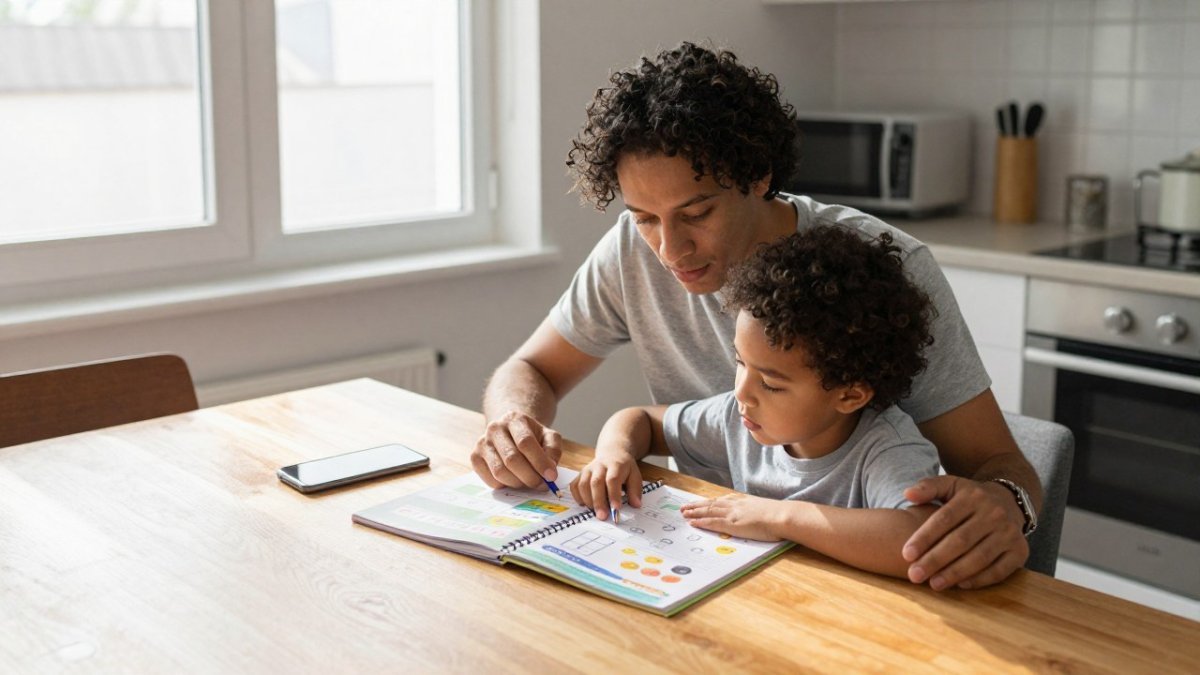
Math homework anxiety spikes at home because the audience is a parent, not a teacher. A consistent routine usually works better than a lecture. Try this:
- Start with the easiest problem to build momentum.
- Ask leading questions ("What do you already know about this?") instead of giving answers.
- Let the child think aloud while you listen.
- Take a two-minute break at the first sign of tears.
- End on a problem they can solve.
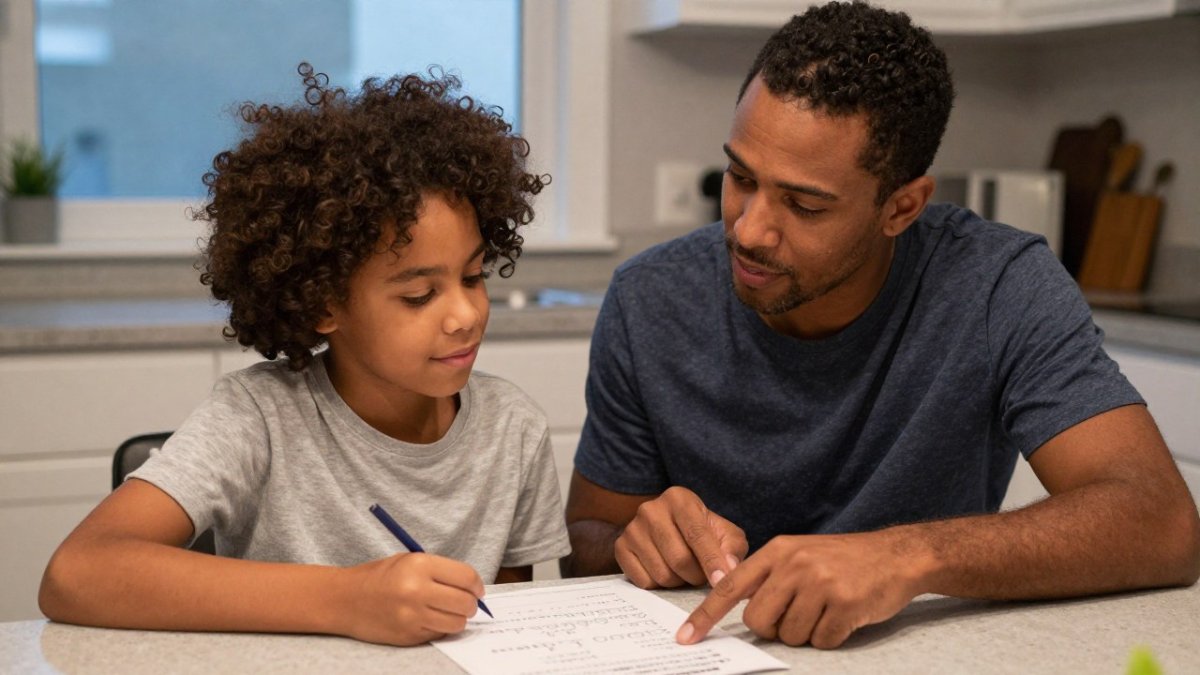
When the method itself looks unfamiliar, our guide on why your child's math homework looks so different walks through worked examples you can use at the table. A common mistake is jumping in with the way you learned it.
Building Math Confidence Through Small Successes
Confidence comes from evidence, and evidence comes from small wins. Confidence building works best when a child can point to something they got right today. Our step-by-step guide on checking homework without doing it for them gives you a five-step version of this routine.
Keep a simple log of wins. Three solved problems a night adds up to real math skills over a term.
A Step-by-Step Response Plan for Moments of Acute Anxiety
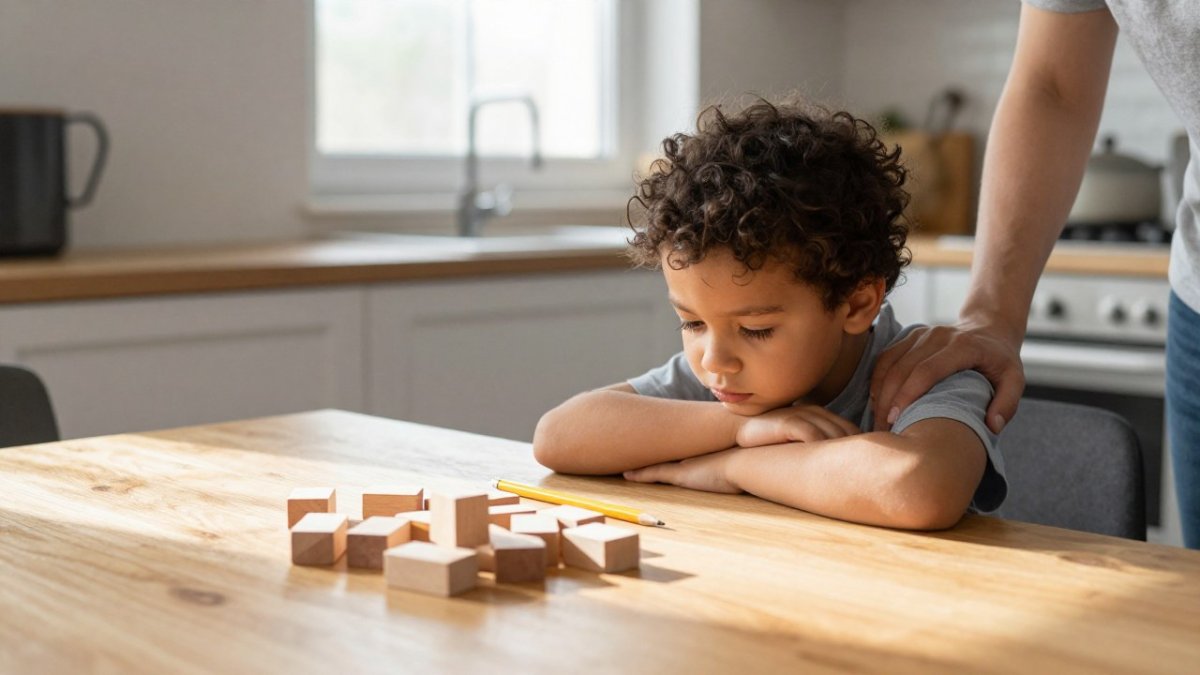
When anxiety peaks, stop teaching and start calming. A practical response plan:
- Pause the task. Close the book for two minutes.
- Name the feeling. "This feels hard, and that's okay."
- Breathe together. Four slow breaths.
- Shrink the step. Do one line, not the whole page.
- Return gently. Restart with a problem they know.
Watch out: pushing through tears teaches a child that math equals distress. That lesson sticks longer than any formula.
When anxiety peaks, follow these steps in order rather than pushing through the worksheet.
| Step | What to do |
|---|---|
| 1 | Pause the task and close the book for two minutes |
| 2 | Name the feeling: "This feels hard, and that's okay." |
| 3 | Breathe together, four slow breaths |
| 4 | Shrink the step: do one line, not the whole page |
| 5 | Return gently, restarting with a problem they know |
Telling Math Anxiety Apart From Skill Gaps and Learning Differences
Anxiety and skill gaps can look identical from the kitchen table. The difference is timing. An anxious child often knows the method but freezes under pressure. A child with a skill gap struggles even in calm, low-pressure moments. If a child reads slowly, reverses numbers, or avoids reading instructions, a learning difference may be involved. Our guide on homework help for kids with dyslexia covers reading-based support.
Tracking Progress and Coordinating Home-School Support
Progress tracking turns a vague worry into something measurable, and coordinated home-school support works because the child hears the same message in both places.
What to track (and what not to)
Avoid reducing progress to test scores. Track observable behaviors that signal confidence and participation, weekly:
- Avoidance behaviors: how often the child stalls, asks to leave the room, or says "I can't" before starting.
- Independent starts: how often the child begins a math task without a prompt or negotiation.
- Persistence: how many attempts the child makes before asking for help.
- Help-seeking: whether the child asks a specific question ("I don't get step 2") versus a global one ("I don't get any of it").
- Recovery time: how long it takes to return to the task after a frustration moment.
A simple shared sheet with these five columns, filled in by both parent and teacher, gives a fuller picture than either setting alone.
A shared language and routine
The child should hear the same phrases at home and at school. Agree on three to five consistent lines, for example:
- "What do you already know about this?"
- "This feels hard, and that's okay."
- "Show me your thinking."
- "Let's shrink the step."
Agree on a routine too: the same hint-first sequence (smallest nudge, then let the child finish) used in both places. When the language and sequence match, the child doesn't have to relearn the emotional rules of math in each setting.
A short, regular communication loop
A weekly two-line note or a shared digital document beats a single parent-teacher conference. Teachers can note one strength and one focus; parents can note one win and one friction point.
Watch out: if the home and school notes start to contradict each other (for example, the child is calm at school but melts down at home), that is useful information, not a failure.
Parents also need to protect their own energy; our article on managing homework stress for parents covers how to sustain the routine without burning out.
Download the App and Make Tonight's Homework Calmer
The hardest part of supporting a child with math anxiety is often the method itself. When a worksheet uses a strategy you never learned, explaining it calmly is tough. That's where K5 Homework Aid For Parents helps.
If tonight's homework ends in tears again, you don't have to guess your way through it. K5 Homework Aid For Parents gives you age-appropriate explanations that match classroom methods, so your child learns the why, not just the answer.
Frequently Asked Questions
What are common signs of math anxiety in elementary students?
Watch for math anxiety symptoms that show up before or during math work: stomachaches or headaches on math days, tears or anger at homework time, claims of being bad at math, avoidance of math homework, freezing on tests, and refusing to try problems without help. Younger children may act out or shut down instead of saying they are worried. A pattern of these reactions across several weeks, especially when reading or other subjects go fine, is the clearest signal to act on.
How can I help my child with math homework anxiety without giving away the answers?
Ask leading questions instead of solving the problem: What is the question asking? What do you already know? Can you show me the first step? Let your child think aloud while you write nothing down. Keep sessions short, use worked examples from class, and praise the effort and the method rather than the correct number. If the method at school has changed since you learned it, an app like K5 Homework Aid For Parents can provide age-appropriate explanations that mirror the methods used by teachers.
Can math anxiety affect a child's performance even when they understand the math?
Yes. A child can know the math facts and formulas and still score poorly when the stress response takes over during a test. Working memory gets tied up in worry, so steps get skipped and careless errors pile up. That is why a low test score alone does not prove a skill gap. Compare how your child does on low-stakes practice at home with how they do on timed or graded work. A large gap between the two points to anxiety rather than missing knowledge.
When should I seek extra help for a child with math anxiety?
Ask the teacher for a private check-in if the distress lasts more than a few weeks, if your child starts refusing school or homework entirely, or if math grades fall while other subjects stay steady. A teacher can help you tell anxiety apart from a skill gap or a learning difference. If your child shows physical symptoms like stomachaches, sleep problems, or panic that do not ease with calmer practice, talk to your pediatrician or school counselor as well.