 how-to
7 Ways to Support Auditory Learners at Home
Last Updated: October 26, 2026
Quick Summary
Support auditory learners at home by reading assignments aloud, asking your child to explain their thinking, and narrating your reasoning through problems. These conversational approaches help auditory learners process information through listening and speaking rather than silent reading.
- Read textbooks, assignments, and notes aloud instead of letting your child read silently.
- Ask your child to explain concepts back to you before they write answers down.
- Use a five-step homework method: read aloud, ask what they notice, explain out loud, have them talk through it, and check in while they work.
- Try activities like the two-minute expert game, teaching a stuffed animal, or recording themselves explaining concepts.
- Adjust conversation length and complexity based on your child's age, from five-minute activities for ages 5-7 to debates and summaries for ages 11+.
Table of Contents
- Understanding Your Child's Auditory Learning Style
- How to Help Auditory Learners with Homework
- Activities for Auditory Learners That Strengthen Understanding
- Study Tips for Auditory Learners to Build Confidence
- Reading Aloud to Children for Learning and Retention
- Using Tools to Support Auditory Learners at Home
- Getting Started with Auditory Learning Support
- Frequently Asked Questions
Understanding Your Child's Auditory Learning Style
Auditory learners process information best through listening and speaking. If your child asks lots of questions, talks through problems, or remembers things better after hearing them aloud, they're likely one.
Recognizing this preference is the first step to supporting auditory learners at home.
Auditory learners may prefer dialogue, explanation, and the chance to talk about what they're learning.
Small changes to how you present information can make a huge difference.
How to Help Auditory Learners with Homework
One approach to supporting auditory learners with homework is to talk through the work before your child writes anything down. Read the assignment aloud, ask your child to explain what it's asking, listen, then fill gaps with your own explanation.
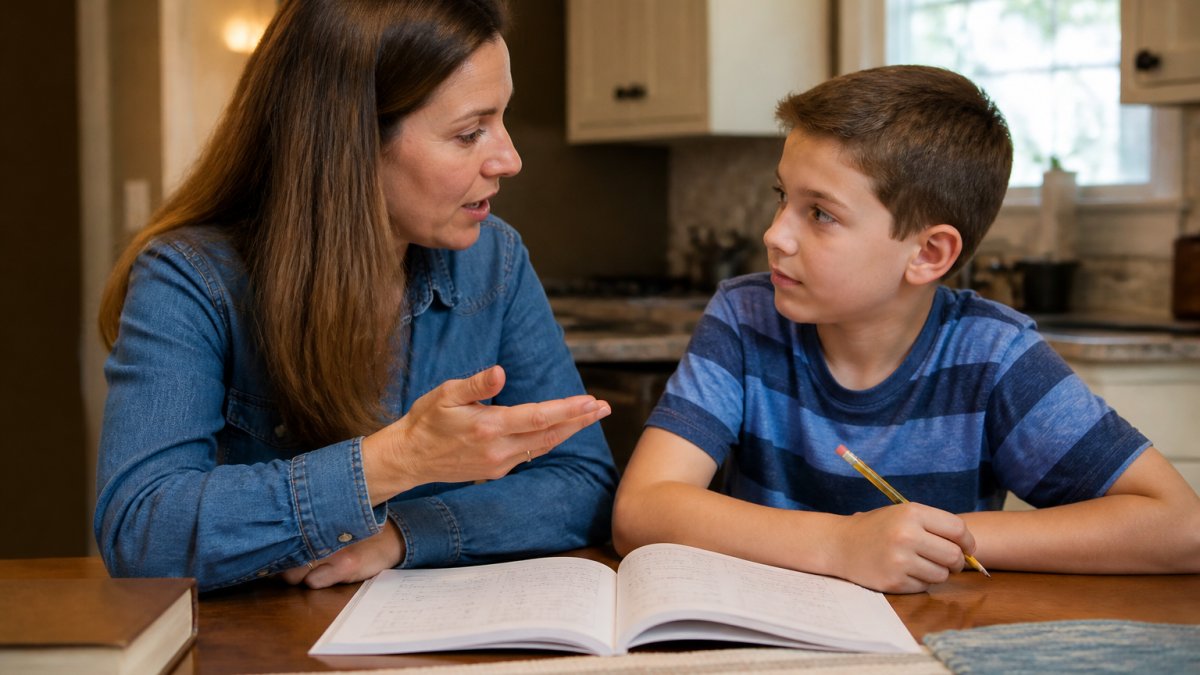
Here's a repeatable method that works across subjects:
- Read the assignment aloud together. Don't let your child read silently. Your voice helps them process the words.
- Ask what they notice. "What do you think this is asking you to do?" Listen to their answer without correcting immediately.
- Explain the method out loud. Walk through how to solve or approach the problem. Narrate each step.
- Have them talk through it. Before writing, ask your child to explain the steps back to you. This cements understanding.
- Check in while they work. Sit nearby and ask questions: "What's your next step?" or "Why are you doing that?"
Narrating your reasoning can help explain the method behind an answer.
What the method looks like in real subjects
Maths, two-digit subtraction with regrouping. Read the problem aloud: "62 minus 38." Ask what your child notices ("the top number is smaller in the ones place").
Reading, a comprehension question about a story. Read the question and relevant paragraph aloud. Ask what the question is really asking ("What happened, or why?").
Science, why plants need water. Read the assignment aloud, then ask what your child already knows. Narrate the cause-and-effect chain: "Water carries nutrients from the soil up through the stem to the leaves.
How to check understanding without turning it into a test
You can check understanding through conversation. These low-pressure prompts offer alternatives to asking "Do you understand?":
- Teach-back: "Explain this to me like I'm your younger cousin."
- Predict-then-check: "What do you think the next step is?" Let them commit to an answer before you confirm.
- Find the mistake: Work a problem aloud and make a deliberate error. Ask your child to catch it. This tests understanding without the pressure of being tested.
- Ask for an example: "Can you think of a time this would matter outside school?"
- Watch for the pause: Ask a smaller question rather than repeating the big one.
When you don't understand the subject yourself
Many parents hit a topic they don't remember well, long division, fractions, a science unit they never studied. You don't need to be the expert, just the conversation partner:
- Learn alongside your child. Say so out loud: "I need to think through this too. Let's figure it out together." Reading the textbook aloud and summarizing it models exactly the skill your auditory learner needs.
- Use the school's materials first. Textbooks, teacher notes, and class examples are usually written at the right level. Read them aloud together before reaching for outside help.
- Know when to escalate. If you're both stuck after a genuine attempt, write a short note to the teacher describing what you tried. Most teachers would rather hear about the confusion early than see incomplete work with no explanation.
Ask questions as well as giving answers.
Activities for Auditory Learners That Strengthen Understanding
Activities for auditory learners can involve speaking, listening, and discussion.
Try these approaches during study time:
- Explain it back to you. Ask your child to teach you the concept. This forces them to organize their thinking aloud.
- Use real-world examples. Connect schoolwork to things your child sees or does, how math applies to cooking, or how science explains why plants need water.
- Create a study buddy system. Have your child explain the material to a sibling, friend, or even a stuffed animal. Speaking reinforces learning.
- Play question games. Take turns asking and answering questions about the topic. Make it fun, not like a quiz.
- Record themselves explaining. Many auditory learners benefit from hearing their own voice. Have them record a short explanation and listen back.
- Discuss the "why" behind concepts. Don't just teach the what. Talk about why things work the way they do.
These activities invite active conversation, your child isn't just receiving information but producing it.
Match the activity to your child's age
Adjust the length, vocabulary, and how much you lead to suit your child.
Ages 5-7 (early primary). Keep activities short, five to ten minutes, and concrete. Use a toy or puppet as the "student" and let your child be the teacher. Ask simple recall questions ("What sound does the letter make?") and accept one-word answers before asking for a sentence.
Ages 8-10 (middle primary). Children this age can handle longer explanations and more back-and-forth. Try a "two-minute expert" game: your child explains a topic for two minutes while you listen, then ask one follow-up question.
Ages 11+ (upper primary). Older children can debate, compare, and summarize. Ask them to argue both sides of a question ("Should the character have done that?"), or summarize a chapter in three sentences aloud.
Subject-specific activity examples
- Maths: Have your child narrate each step of a word problem aloud before writing the number sentence. Play "spot the error" by reading a solved problem with one deliberate mistake and asking them to find it.
- Reading: Take turns reading a page aloud, then each summarize what happened in one sentence. For vocabulary, have your child use a new word in a spoken sentence about their own life.
- Science: Ask your child to explain a process (the water cycle, how a plant grows) as a story with a beginning, middle, and end. Have them predict what happens next in an experiment and explain why.
- History or social studies: Have your child retell an event as if telling a friend, then ask one "why" and one "how do you know" question.
Adapting activities for attention, language, and learning needs
Some children may find talking difficult or feel anxious about speaking. A few adjustments may help:
- Shorten the turn. Instead of a full explanation, ask for one sentence at a time, with praise between turns.
- Give thinking time. Count silently to five before expecting an answer. Rushing closes down conversation.
- Offer a choice of format. Some children explain better while drawing, building, or walking than while sitting still.
- Model first. Do the first turn yourself so your child hears what a good explanation sounds like.
- Use sentence starters. "This works because…" or "The first step is…" lowers the load for children who struggle to begin.
Adjust activities by your child's age and developmental stage.
| Age Group | Duration | Activity Type | Key Focus |
|---|---|---|---|
| Ages 5-7 | 5-10 minutes | Toy or puppet as student | Simple recall, one-word answers |
| Ages 8-10 | Two minutes | Two-minute expert game | Linking ideas with because and so that |
| Ages 11+ | Longer format | Debate and summarize | Compare, argue both sides, three-sentence summaries |
Study Tips for Auditory Learners to Build Confidence
Study tips for auditory learners can focus on routines that use sound and speech.
Build these habits into your routine:
- Read textbooks and notes aloud, Don't let your child read silently. Have them read passages aloud or listen while you read.
- Use a consistent study spot, A quiet place where your child can speak without feeling self-conscious helps auditory learners think aloud.
- Study in short bursts, Try study blocks with breaks between.
- Summarize verbally, After studying, have your child summarize what they learned in their own words.
- Create a study schedule your child can anticipate, Predictability reduces anxiety and helps auditory learners prepare mentally.
You can try keeping homework at the same time and place each day.
Reading Aloud to Children for Learning and Retention
Reading aloud is one way to support auditory learners. Parents can continue reading text aloud after their child begins reading independently.
When you read aloud, your child hears the rhythm and flow of language. Reading together can be a shared activity.
How to make reading aloud work:
- Choose books slightly above their independent reading level, This challenges their comprehension without frustrating them.
- Pause to discuss, Don't just read straight through. Stop and ask questions: "What do you think happens next?" or "Why did that character do that?"
- Use different voices for characters, This keeps auditory learners engaged and helps them track who's speaking.
- Connect reading to their schoolwork, If they're learning about a topic in class, find stories or books related to it.
- Make it a daily habit, Even 10-15 minutes of reading aloud builds vocabulary and comprehension over time.
Using Tools to Support Auditory Learners at Home
Tools to support auditory learners at home can provide additional ways to access information.
Text-to-speech can let your child listen to an assignment while reading along.
K5 Homework Aid For Parents includes text-to-speech accessibility. The app automatically detects the grade level from a photo of the assignment and provides age-appropriate explanations that mirror the methods used by teachers.
Beyond text-to-speech, consider:
- Audiobooks, Many classics and learning materials are available as audiobooks. Your child can listen during car rides or downtime.
- Educational podcasts, There are podcasts on nearly every subject. Find ones your child enjoys and listen together.
- Talking calculators, These speak numbers aloud, helping auditory learners track their work.
- Recording devices, Let your child record themselves reading notes or explaining concepts, then listen back for review.
You can combine these tools with conversation.
You can also explore Support Auditory Learners With Homework: A Parent's Guide for homework-specific strategies, or check out How do you explain school concepts to primary kids? for techniques on explaining concepts aloud. For text-to-speech implementation, see Using Text-to-Speech for Homework: A Parent's Guide, and for broader tool options, explore Best AI Study Tools for Elementary Kids in 2026.
Getting Started with Auditory Learning Support
You can try talking more during homework. Ask questions. Listen to your child's thinking. Narrate your own reasoning.
From there, add one or two strategies above. You don't need to overhaul everything at once.
The goal isn't perfection. It's creating an environment where your child feels heard.
K5 Homework Aid For Parents provides age-appropriate explanations with text-to-speech support. Download Free.
Frequently Asked Questions
How can I tell if my child is an auditory learner?
Some children may prefer listening to instructions or discussing ideas. These preferences alone do not establish a learning style.
How can I explain a difficult subject to an auditory learner?
Start by speaking the concept aloud in simple terms, then ask your child to repeat it back to you in their own words. Use real-world examples and analogies they can relate to. Encourage questions and discussion rather than lecturing. For complex topics like fractions or grammar rules, break them into smaller pieces and talk through each one. Pause frequently to check understanding. Tools like text-to-speech can reinforce explanations by reading content aloud, helping your child process the information through multiple listening opportunities.
Do auditory learners benefit from reading aloud?
Reading aloud is one way to present text through listening. For homework, your child can read questions aloud or use text-to-speech to hear assignments read to them.
What's the best way to check if my auditory learner actually understands the homework?
You can ask them to explain the concept or problem-solving method aloud, rather than checking only whether they got the right answer. You might ask: 'Can you tell me how you solved that?' or 'Explain why this method works.' You can frame it as a conversation rather than a test.