 How-to
Preventing Kids From Copying Homework Answers
Last Updated: November 12, 2026
Quick Summary
Preventing kids from copying homework answers starts with finding the real cause, whether it is grade pressure, a time crunch, peer pressure, or a skills gap, and then fixing the setup rather than just punishing the child. Teach your child to ask for explanations instead of answers, rehearse refusal scripts for friends who want to copy, and keep devices and answer apps out of reach during homework hours.
- Copying homework is rarely about laziness; most kids copy to escape a bad feeling like panic or fear of falling behind.
- A child who copies in only one subject usually has a skill gap, not a character flaw.
- The line is simple: if a child cannot explain the answer in their own words, it was not their work.
- When copying already happened, cool down for an hour before talking and find the cause before setting a consequence.
- A family AI rule: ask for the why, not the what, and have your child write an attempt first.
Table of Contents
- Why Students Cheat on Homework: The Real Reasons Behind Copying
- How to Help Kids With Homework Without Giving Answers
- What Counts as Copying: Drawing the Line Between Collaboration and Cheating
- What to Say When Someone Wants to Copy Your Homework
- Homework Independence Strategies for Parents
- A Step-by-Step Plan for When Copying Homework Already Happened
- Digital and AI Safeguards That Keep Answers Out of Reach
- Set Up Your Homework Routine With K5 Homework Aid For Parents
- Frequently Asked Questions
Why Students Cheat on Homework: The Real Reasons Behind Copying
Copying homework is rarely about laziness. Most kids who copy are trying to escape a bad feeling: the panic of a blank page, the fear of falling behind, or the sting of disappointing someone. Working parents often describe the same story: the tears start, the clock runs out, and copying feels like the only way out.
That matters because the fix depends on the cause. Punish a scared kid and you get a sneakier scared kid.
Grade Pressure, Time Crunch and Peer Pressure
Three forces push most copying homework:
- Grade pressure. A child who believes a bad grade equals failure will grab the fastest route to a good one.
- Time crunch. Overscheduled evenings leave no room to struggle productively.
- Peer pressure. Friends ask for answers, and saying no feels riskier than cheating.
When Copying Is Really a Skills Gap
Sometimes the child cannot do the work, not won't. Reading fluency, working memory, or a missing method from last year all create gaps that look like attitude.
Watch for a child who copies only in one subject. That pattern usually points to a skill gap, not a character flaw. We cover this in more detail in how do you stop a child from copying homework.
How to Help Kids With Homework Without Giving Answers
The best help is a question, not an answer. When you supply answers, you teach a child to wait for rescue. When you ask questions, you teach a child to think.
Try these prompts the next time your child is stuck:
- "What part of this makes sense so far?"
- "What did your teacher do first in the example?"
- "If you guessed, what would you try?"
- "Where did you get stuck last time?"
- "Can you show me with your fingers or a drawing?"
Questions That Prompt Thinking Instead of Answers
Notice what these questions avoid: the solution. They hand the thinking back to your child, which is the whole point.
A common mistake is asking "Do you understand?" Kids say yes to end the conversation. Ask "Can you teach it back to me?" and you get the truth.
For a full routine, see how to check homework without doing it for them.
What Counts as Copying: Drawing the Line Between Collaboration and Cheating
Copying is submitting someone else's work or answers as your own. Collaboration is working through a problem together, then writing your own response. The line is simple: if a child cannot explain the answer in their own words, it was not their work.
Here is how we draw the line in practice:
| Situation | Collaboration or Copying? | Why |
|---|---|---|
| Two kids quiz each other before a test | Collaboration | No work is submitted |
| One child explains a method, the other redoes it | Collaboration | Both do the thinking |
| A friend reads answers aloud | Copying | No thinking happens |
| Kids split problems, then swap answers | Copying | Work is not their own |
| Child uses a source and cites it | Collaboration | Credit is given |
| Child cuts and pastes from a search engine | Plagiarism | No attribution, no learning |
The tell is always the same: can your child walk you through the steps without the paper in front of them?
Age-by-Age Examples of the Line
The same behavior can be collaboration in second grade and copying in fifth. Use these examples to make the rule concrete for your child:
- Grades K-2: Sharing a box of crayons and talking through a drawing is collaboration. Copying a friend's spelling words is copying, because the point is to practice the sound-spelling link yourself.
- Grades 3-4: Working in a pair to solve one math problem on a whiteboard, then each writing the steps in your own notebook, is collaboration. One child solving all the odd problems and the other solving all the even ones, then trading answers, is copying.
- Grade 5 and up: A study group that quizzes each other and explains missed questions is collaboration. A group chat where someone posts a photo of completed answers is copying, even if everyone retypes them.
A common pattern: children in the same grade often disagree about where the line sits because teachers set different rules. When that happens, the stricter classroom rule wins for schoolwork, and the family rule wins at home.
Role-Play the Boundary Before It Comes Up
Kids freeze when a friend asks for answers, so rehearse the moment in advance. Try a two-minute role-play where you play the friend and your child practices one of these responses:
- "I can't give you the answers, but I'll quiz you for ten minutes."
- "Let's work on it together at lunch, but you write yours."
- "I already turned mine in, so I can't send it."
After the role-play, ask your child how it felt to say no. Naming the discomfort out loud makes it easier to repeat in real life.
Watch out: if you only role-play the polite refusal and never the pushback, your child may cave the second time a friend asks. Practice one follow-up line such as "I'm not comfortable with that" so the refusal holds.
When Collaboration Slips Into Copying
Three warning signs tell you a study session crossed the line:
- One child holds the pencil the whole time. If only one person writes, only one person is learning.
- The answers match word for word. Identical phrasing, including the same mistakes, is a strong signal.
- Your child cannot explain the work the next day. Retention is the proof of collaboration.
If you spot these signs, treat it as a routine correction rather than a character judgment. Say, "This looks like it turned into copying. Next time, try quizzing each other instead." Then move on. The goal is to keep the study habit while fixing the boundary.
What to Say When Someone Wants to Copy Your Homework
Kids need actual words, not a lecture about integrity. Practice these scripts at home so your child has them ready:
- "I can't give you the answers, but I'll quiz you for ten minutes."
- "Let's work on it together at lunch, but you write yours."
- "I already turned mine in, so I can't send it."
If the friend pushes, a simple "I'm not comfortable with that" ends it. Rehearsing once is enough. Kids freeze when they improvise.
Homework Independence Strategies for Parents
Independence is a routine, not a personality trait. Build the routine and the copying impulse fades, because your child has a plan for getting unstuck that does not involve a classmate's paper.
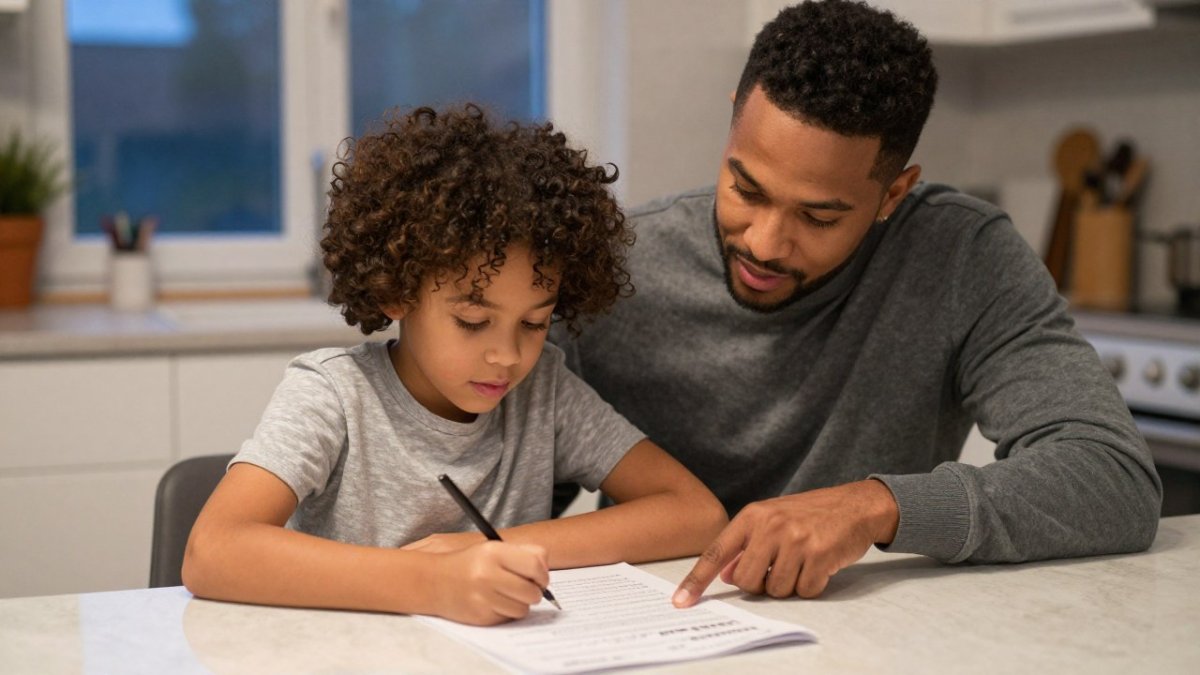
Set up four habits:
- Same time, same place. Predictability cuts the stalling.
- Hint first, help second. Offer a nudge before an explanation.
- Explain-back check. Your child teaches you one answer each night.
Age-by-Age Expectations for K-5 Students
- K-1: 10-15 minutes of supervised work; you read directions aloud.
- Grades 2-3: 15-25 minutes; your child starts alone, you check after.
- Grades 4-5: 30-45 minutes; your child plans the order and asks for help by choice.
For broader guidance, read how to help elementary child with homework.
A Step-by-Step Plan for When Copying Homework Already Happened
Copying homework will happen in most households at some point. What you do next decides whether it becomes a habit or a one-time mistake. Stay calm, get the facts, and treat it as a teaching moment.
- Cool down first. Wait an hour before talking. Anger produces confessions, not understanding.
- Ask open questions. "Walk me through how you did this one." Listen for gaps.
- Name it without shame. "This looks copied. That's not okay, and I want to understand why."
- Find the cause. Time? Skills? Pressure? Fear of your reaction?
- Set a consequence that teaches. Redo the work with help, plus a short break from a privilege.
- Loop in the teacher if it happened at school. Honest communication beats a surprise call later.
- Fix the setup. Change the routine so the same pressure does not rebuild.
Watch out: skipping step four turns the whole plan into punishment without a cure, and the copying returns within weeks.
Digital and AI Safeguards That Keep Answers Out of Reach
Search engines and AI tools hand out answers in seconds. That is exactly why safeguards matter more than bans. Blocking everything teaches nothing; a child who meets a locked door at home will find an open one at a friend's house.
Set these up on family devices:
- Search in safe mode. Turn on safe search on every browser and device.
- No answer apps during homework hours. Photo-solver apps stay off the homework table.
- AI use with a rule. Kids may ask for an explanation, never a finished answer.
Name the Apps and Set the Rules
Generic bans fail because children meet the same tools at a friend's house. Instead, name the common categories and agree on a rule for each:
- Photo-solver apps (for example, camera-based solvers): allowed only to check work after the child has written an answer, never to produce the first answer.
- Answer-sharing sites (for example, Brainly and similar Q&A boards): off during homework hours; if used for research, the child must rewrite in their own words and note the source.
- Messaging apps and group chats: phones stay in another room during homework unless the assignment requires collaboration, and group chats are for questions, not answer photos.
A Homework-Hour Device Setup
A predictable setup beats a daily argument. Try this sequence:
- Park the phone. Devices go in a basket in another room unless the assignment needs them.
- Open only the needed tab. If the assignment requires research, open the browser to the specific site together.
- Use a child-safe browser profile. Turn on safe search and block known answer sites in the browser settings.
- Review history weekly, not nightly. A weekly glance catches drift without turning homework into surveillance.
Watch out: checking history every night can push a child to use a friend's device instead. Keep the review low-key and predictable so the rule feels like a routine, not a trap.
AI-Specific Rules That Teach Instead of Ban
AI tools are now part of homework for many families, so a blanket ban is unrealistic. A workable family rule has three parts:
- Ask for an explanation, not an answer. "Explain how to solve this type of problem" is allowed; "Solve this problem" is not.
- Show your work first. The child writes an attempt before opening an AI tool, so the tool checks thinking rather than replacing it.
- Cite AI help. If an AI tool explained a method, the child notes it the way they would note a textbook page.
These rules mirror what many teachers now expect, and they keep the learning with the child. For a deeper look at choosing tools, read is AI homework help safe for kids and our guide to .
The same principle guides our own app. K5 Homework Aid For Parents detects the grade level from a photo and provides explanations designed to show the why, not just the answer.
Set Up Your Homework Routine With K5 Homework Aid For Parents
Copying thrives in confusion. Clear rules, honest scripts, and a steady routine starve it.
K5 Homework Aid For Parents makes that easier. Snap a photo of an assignment and the app detects the grade level, then gives age-appropriate explanations.
Get started with K5 Homework Aid For Parents and turn homework fights into real understanding.
The next time your child is stuck, resist the urge to hand over the answer.
Frequently Asked Questions
Is copying homework illegal?
Copying homework is not a criminal offence, but it is academic dishonesty and schools treat it as a discipline matter. Consequences usually range from a warning and a redo to a zero on the assignment and a note home. The bigger cost is to student learning: a child who copies answers skips the practice that builds understanding. Schools publish their academic integrity rules, so check your child's handbook so you can explain the exact consequences before an incident happens.
How can I tell whether my child understands their homework or is just copying?
Ask them to explain the method out loud, not just show the finished page. A child who understands can walk you through why they chose a step and what they would do if the numbers changed. Try a quick variation: cover the answer, change one detail, and ask them to solve it again. If they can talk through the reasoning, the understanding is there. If they freeze, they need an explanation of the concept, which is where an app like K5 Homework Aid can walk them through the teacher's method.
What should I say when my child copies homework answers?
Stay calm and lead with curiosity rather than accusation. Try: I noticed these answers look copied. Can you tell me what happened? Then explain the rule plainly, name the consequence at school, and agree on a fix such as redoing the work with support. Ask what made copying feel easier than asking for help, since grade pressure, time and confusion are common triggers. Finish by setting a routine that removes the temptation, like a set homework time and a check-in before the assignment is due.
How do I help with homework without just giving the answer?
Answer questions with questions. Ask what the assignment is asking, what your child already tried, and where they got stuck. If they are truly lost, explain the method step by step and then have them repeat it on a fresh problem. Keep your hands off the pencil: you can point, prompt and encourage, but they should do the writing.